News and events header (2)

Presentation: Towards a New Social Pact. Labor, Welfare, and Ecological Sustainability in the Twin Transition

Andrea Ciarini, Associate Professor of Economic and Labor Sociology at Sapienza University of Rome, will present his latest book “Towards a New Social Pact. Labor, Welfare, and Ecological Sustainability in the Twin Transition”, published by Donzelli, in conversation with Enrica Morlicchio, University of Naples “Federico II”, Mimmo Carrieri, Sapienza University of Rome, and Angelo Salento, University of Salento.

The meeting will be moderated by Mattia Vitiello (CNR-IRPPS).
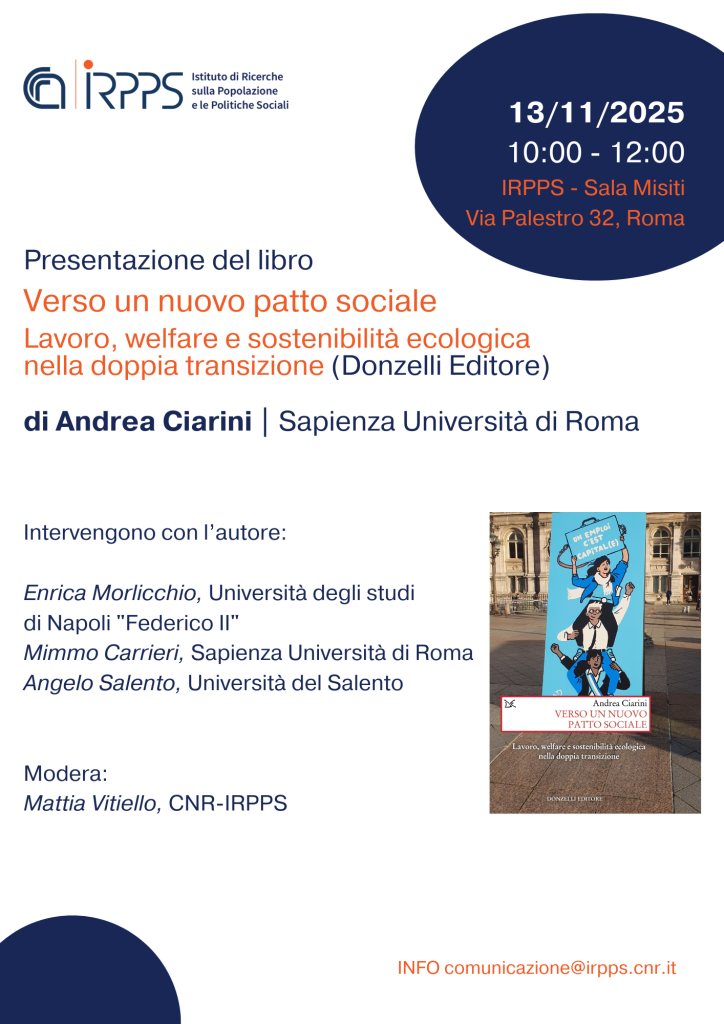
Event Program

Sustainability issues have fully entered the political and economic agenda. Yet, the twin transition—ecological and digital—is proving to be anything but linear, and even less equitable. The promises of green growth and technological innovation are clashing with the emergence of new inequalities, which add to existing ones, fueling insecurity and tension. Those most affected are social groups who fear losing their acquired status or being penalized by transformations perceived as uncontrollable. The intertwining of environmental, economic, and social issues can no longer be addressed simply as a matter of sustainable development policies, nor reduced to compensatory measures for those at risk of being left behind. Rather, it is the testing ground on which the interests at stake and the profound transformations radically redefining the landscape of work and social protection systems are measured. Hence the urgency of a new social pact that can bring together economic needs, social justice, and environmental sustainability. Starting from a critical analysis of current policies and their limitations, this volume proposes an alternative perspective, indicating concrete solutions to make the transition not only just but also desirable in terms of quality of life and collective well-being.

Andrea Ciarini is Associate Professor of Economic and Labor Sociology at the Department of Social and Economic Sciences of Sapienza University of Rome, where he teaches Economic Sociology and Sociology of Welfare. His books include Politiche di welfare e investimenti sociali (2020) and Le politiche sociali nelle regioni italiane. Costanti storiche e trasformazioni recenti (2013), both published by il Mulino.

Read More
News and events header

Closing conference of the PRIN Well-Mig project

The conference “Migration and Subjective Well-Being in Italy and Europe. Final Conference of the WELL-MIG Project: Indicators, Narratives, and Policy Perspectives” took place on Tuesday, September 16, 2025, in the Sala Misiti of the CNR-IRPPS in Rome.

The study day, marking the conclusion of the PRIN project The subjective well-being of immigrants and natives: Italy in the European context (WELL-MIG), coordinated by IRPPS-CNR and carried out with the Department of Methods and Models for Economics, Territory and Finance (MEMOTEF) of Sapienza University of Rome, was dedicated to the links between migration, integration, and subjective well-being.

The first session, moderated by Corrado Bonifazi, featured a presentation by Angela Paparusso (CNR-IRPPS), who presented the main results of the WELL-MIG project and future perspectives, followed by a keynote speech by Claudia Finotelli (Complutense University of Madrid) on citizenship, integration, and well-being in Italy and Spain.

In the second session, coordinated by Frank Heins, traditional and innovative indicators of subjective well-being were discussed with contributions from Alberto Arcagni, Martina Bodo, and Daniela Foresta, who addressed mental health, transitions to adulthood, and the well-being of adolescents, both natives and migrants, respectively.

The afternoon was dedicated to subjective well-being and migration narratives, moderated by Mattia Vitiello. Following the keynote lecture by Paolo Boccagni (University of Trento) on the temporal, spatial, and relational dimensions of well-being in migration, Stefano degli Uberti and Cecilia Fortunato gave their presentations.

The day concluded with a discussion and final reflections by Giorgio Alleva and Elena Ambrosetti (Sapienza University of Rome).

Angela Paparusso was the scientific and organizational lead for the initiative.

Read More
Header news and events (11)

CNEL Report 2024 – Demographics and Labor Force

In the “CNEL Report 2024 – Demographics and Labor Force“, Corrado Bonifazi and Angela Paparusso analyze the growing impact of immigration on Italian demographics and economy, highlighting how migration flows are essential to sustain the country’s labor market.

With a constantly aging population and a declining labor force, immigration emerges as a fundamental factor for demographic renewal and strengthening of the production system.

Bonifazi and Paparusso propose more effective migration policies and integration strategies that can strengthen the positive contribution of immigrants, fostering greater social cohesion and more sustainable management of human resources.

For more information, please consult the full Report and read the news on the CNEL website.

Read More
1

Book Presentation “Prima agli italiani”

Thursday, November 14, 2:30 PM

G. Marconi Library – CNR, Piazzale Aldo Moro 7, Rome

Read More
News and events header (7)

Award presented to the book Social History of Italian Emigration

The book Social History of Italian Emigration: From Unification to the Present, by Enrico Pugliese and Mattia Vitiello and published by Il Mulino, has received the 2024 Memorie Migrate Award from the Municipality of Castelluccio Inferiore.

The volume adopts a historical-sociological approach to the history of Italian emigration abroad, highlighting the significance of emigration in the transformations of our country.

Watch the interview with the authors and read the review in Il Manifesto.

Read More
News and events header (2)

World Refugee Day

On World Refugee Day, we recall the shared Statement on migration promoted by the Convention of the Italian Network of UNESCO Chairs, of which CNR-IRPPS researcher Angela Paparusso is a member.

Read More

WELL-MIG – PRIN

The subjective well-being of immigrants and natives (WELL-MIG)


The subjective well-being of immigrants and natives: Italy in the European context (WELL-MIG) is a PRIN project (Progetti di Rilevante Interesse Nazionale-2022CHTHEF).

It is funded by the Ministry of University and Research (MUR), with a two-year duration, coordinated by IRPPS-CNR and carried out with the Department of Methods and Models for Economics, Territory and Finance (MEMOTEF) of Sapienza University of Rome.

The WELL-MIG project aims to advance knowledge on subjective well-being (SWB) in Italy within the European context, studying its different measures among immigrants and natives, across immigrant generations and over time.

What are the project's objectives?

WELL-MIG will measure the effect of various individual and contextual factors, including the implications of the recent COVID-19 pandemic, on the subjective well-being of different population groups. To do this, the project will:

  • jointly analyze various official surveys conducted in European countries, including Italy, in the period 2015-2022 (WP1);
  • develop new indicators and interpretative models on SWB, based on non-aggregative approaches, and integrating them with traditional ones and
  • analyze social media data to investigate the characteristics and dynamics of the relationship between the population’s subjective well-being and immigration (WP2);
  • study the life stories of immigrants to understand their SWB before and after the migration experience, also in relation to the acquisition of citizenship (WP3).

The WELL-MIG project has important implications not only for science, but also for social cohesion and policymaking. In fact, the project aims to increase awareness of the importance of developing up-to-date survey data and formulating new indicators on SWB at the European level. Furthermore, the work of WELL-MIG will contribute to a deeper understanding of the SWB level of the immigrant population and assist policymakers in implementing factors that improve the population’s SWB.

Read More
Site news header (2)

Scholars at Risk

IRPPS, together with CNR, adheres to Scholars at Risk, an international network that promotes protection activities for scholars in danger, advocacy, and training for academic freedom. A course on “Guidelines for the reception of scholars at risk,” necessary for those wishing to actively participate in the network, is scheduled.

Read More
Design (2)

3 Perspectives on World Population Day

On the occasion of World Population Day, we gathered three different perspectives on population studies at our Institute.

With Angela Paparusso, a demographer in the Population and Migration group, we discussed demographic aging, family models, and migration.
With Patrizia Grifoni, an engineer in the Social Informatics and Technology Assessment group, we focused on the various social implications of the spread of information and communication technologies (ICT).
We asked Daniele Archibugi, an economist in the Globalization, Research and Innovation group, about the current relationship between demographic dynamics and the economy.

Read More

METROmosaic

METROmosaic - THE NEW METROPOLITAN MOSAIC

The METROmosaic project is funded under the 2021 Call “Social and Human Sciences Research for a Changing Society” of the CARIPLO Foundation and is part of the strategic objective “Demographic challenges: experimenting with new responses for a changing society“.

The METROmosaic project has a duration of 30 months and involves 4 research units: CNR-IRPPS, Politecnico di Milano (PI Alessandro Coppola), Sapienza University of Rome and University of Milano-Bicocca.

METROmosaic aims to explore the main current and emerging drivers and patterns of household residential mobility and their complex impacts on diversity, inequality, and socio-spatial cohesion at various scales and in a variety of local contexts within the urban regions of Milan and Rome.

METROmosaic intends to bridge a knowledge gap regarding the phenomenon of residential mobility—or intra-urban mobility—by allowing for:

(i) reconstructing a framework of the phenomenon’s evolution over the last twenty years in the urban areas of Rome and Milan;
(ii) investigating the drivers of residential choices at macro, meso, and micro levels;
(iii) studying the social and demographic effects of residential mobility at the local level;
(iv) considering future scenarios of residential mobility, also in light of the pandemic’s effects on household settlement attitudes.
These aspects are analyzed by considering elements that characterize “metropolitan mosaics” in different urban regions, such as differences in residential mobility patterns and determinants dictated by ethnicity.

The CNR-IRPPS research unit is specifically engaged in the following activities:

– systematic review of the literature on the topic of “intra-urban residential mobility”;
– collection, organization, and harmonization of stock and flow registry databases related to the urban regions of Rome and Milan;
– analysis and identification of settlement and residential mobility patterns in the two urban regions;
– definition of a taxonomy of neighborhoods/municipalities in the two urban regions based on residential mobility trends and the socioeconomic characteristics of the areas;
– planning and organization of a survey on the motivations for residential mobility among residents in the two urban regions;
– planning, organization, and implementation of a qualitative study on the decision-making processes of the population with a migratory background in Rome.

Read More

VAT Number: 02118311006
Tax Code: 80054330586
Certified Email
protocollo.irpps@pec.cnr.it

Rome Office

ROME
Via Palestro, 32; 00185
(+39) 06 492724 217 – 283
segr.irpps@irpps.cnr.it

Salerno Office

FISCIANO
Corso San Vincenzo Ferreri, 12
(+39) 089 891 850 – 851
welfare@irpps.cnr.it

Privacy

Privacy policy

Transparent Administration

Civic Access