25

Technomonarchs – book presentation

  • Thursday, February 26, 2026, at 11.30-13.00
  • Sala Misiti – CNR-IRPPS, via Palestro 32, Rome

Alessandro Mulieri, directeur de recherche at the CNRS in France, will present his latest book “Technomonarchs – The ideologues of the new right attacking democracy”, published by Donzelli, in dialogue with researchers Marco Cellini (CNR-IRPPS) and Tommaso Visone (Link University, CNR-IRPPS), and with journalist Francesca De Benedetti (Il Domani), moderated by Prof. Daniele Archibugi (Mercatorum, CNR-IRPPS).

We have entered the era of technomonarchs. A new reactionary revolution, conceived between Silicon Valley and American right-wing intellectual circles and based on sophisticated surveillance and control technologies, has today become a political program in Washington. Its protagonists are tech entrepreneurs, ideologues, and politicians driven by a worldview based on the return to archaic ideas of inequality, natural hierarchy, and absolute monarchy. Their goal? The end of democracy. (Donzelli editore book profile)

Read More
News and events header (4)

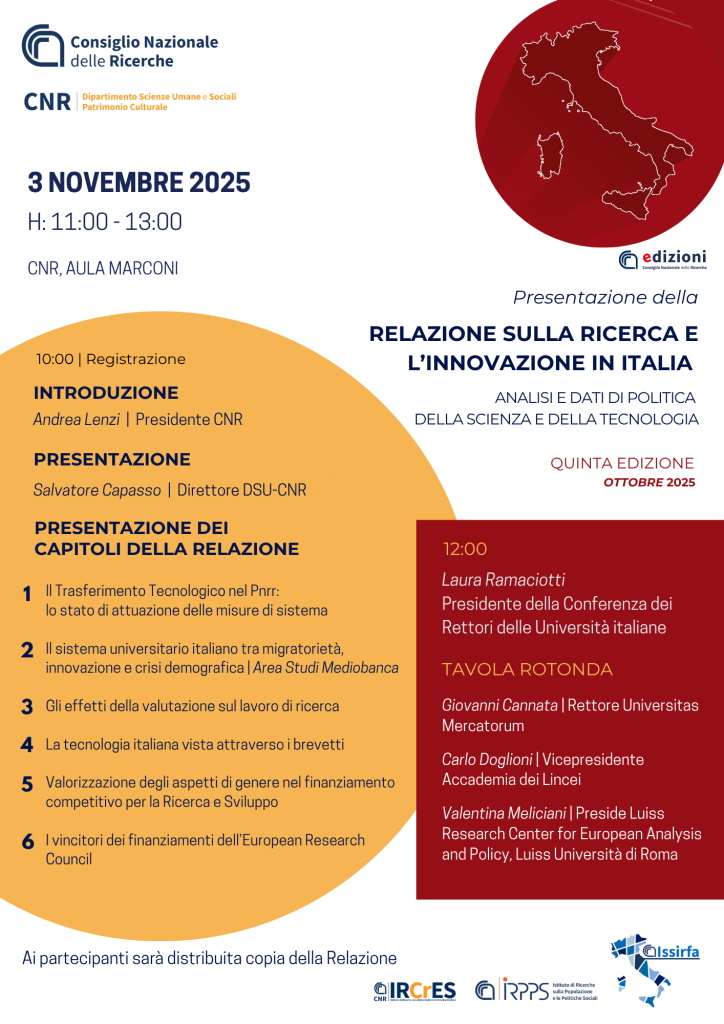
Presentation of the Report on Research and Innovation in Italy

  • Monday, November 3, 2025, at 11.00-13.00
  • Marconi Hall – CNR, Piazzale Aldo Moro 7, Rome
  • Download the program.

On Monday, November 3 at 11:00 AM, the President of the CNR Andrea Lenzi and the Director of the Department of Social Sciences and Humanities, Cultural Heritage of the CNR Salvatore Capasso will present the Fifth Report on Research and Innovation in Italy, produced in collaboration with the Institute for Research on Population and Social Policies (CNR-IRPPS), the Research Institute on Sustainable Economic Growth (CNR-IRCrES), and the Institute for the Study of Regional Federalism and Self-Government (CNR-ISSIRFA).

Participation is free while seats last, with on-site registration.

The Report on Research and Innovation provides quantitative analyses and case studies to inform the debate and policy choices regarding research and innovation. This fifth edition sheds light on the state of technology transfer within the NRRP and patents in Italy, changes in the university system, the effects of evaluation processes on research, and European Research Council projects.

The Report is coordinated by Daniele Archibugi, Emanuela Reale, and Fabrizio Tuzi.

INTRODUCTION Andrea Lenzi | President of CNR PRESENTATION Presentation of the Report chapters Technology Transfer in the NRRP: the state of implementation of system measures The Italian university system between migration, innovation, and demographic crisis | Mediobanca Research Area The effects of evaluation on research work Italian technology seen through patents Enhancing gender aspects in competitive funding for Research and Development Winners of European Research Council grants Salvatore Capasso | Director DSU-CNR 10:00 AM | Registration Giovanni Cannata | Rector of Universitas Mercatorum Carlo Doglioni | Vice President of Accademia dei Lincei Valentina Meliciani | Dean of Luiss Research Center for European Analysis and Policy, Luiss University of Rome ROUND TABLE Laura Ramaciotti President of the Conference of Italian University Rectors 12:00 PM

Read More
News and events header (2)

Presentation of the book “Social Classes in Italy Today”

Tuesday, January 21, 2025 – h. 11.30

Sala Misiti – CNR-IRPPS, via Palestro 32, Rome

Teams live link (Passcode: Z8ie9bm2)

Pier Giorgio Ardeni is a professor of Political and Development Economics at the University of Bologna.

(Book and author profile) Social Classes in Italy Today (Editori Laterza) describes the social differences that remain strong and distinct in Italy, where they limit social mobility, access to education, possibilities, and opportunities. Of course, classes are no longer what they once were because professions and lifestyles have changed, but they still exist, even after we were convinced that they had dissolved in our ‘liquid’ society.
These pages, following step by step how the class structure in Italy has evolved and quantifying the weight of various strata and groups as their characteristics and composition change, aim to show how inequalities in income distribution correspond to differences in profession and educational qualifications, and how social structure still influences power relations. The relative weight of classes has varied, and with it their ‘political’ weight within the channels of representation. A book that aims to demonstrate how classes still exist, indeed, and it is from these that we must start again to rethink the crisis of democracy and representation.

Read More

Illicit labour and the global photovoltaic industry

Illicit Labour and the Photovoltaic Industry (ERC)

Funded by the European Research Council (ERC), the Illicit Labour project involves an international consortium composed of the National Research Council and Queen Mary University of London. The project, coordinated by Dr. Carlo Inverardi-Ferri, introduces a study on the links between climate change mitigation and illicit economies, and the related implications for ecological governance. It investigates the production networks of the photovoltaic industry to reveal the dark side of the green energy sector in various geographical sites (China, Ghana, and India). In doing so, it advances new theoretical perspectives on risk, vulnerability, and mitigation, considering the interaction between the green energy sector and the illicit economy.

The research focuses on several fundamental questions:

  • How do we explain the economic, political, and cultural processes that link illicit labour and ecological governance?
  • What labour regimes in extraction and production processes support the production of solar panels?
  • How do informal energy markets function?
  • What social and environmental challenges emerge from the end of the life cycle of photovoltaic modules?
  • And finally, how can this analysis reveal new ways to provide clean and affordable energy for all?

Climate change mitigation and illicit labour are two significant challenges of modern times, whose interconnection raises growing concerns for society, such as energy insecurity, toxic waste production, and labour exploitation. However, this relationship has surprisingly received limited systematic attention in labour studies. Through an analysis of the photovoltaic industry, a sector of relevance for climate change mitigation, “Illicit Labour” sheds light on those actors, practices, and processes operating in the shadows of sustainable development.

Read More

INNODATA

INNODATA

PRIN – Projects of Relevant National Interest, Ministry of University and Research

Digital INNOvation: an assessment of the relationship between DATA and other intangible assets and productivity (INNODATA)

Digital technologies have by no means exhausted their development. On the contrary, they continue to demonstrate full vigor, increasingly expanding their fields of application. The production of new products, processes, and services is now accompanied by the ability to use new tools for the management and communication of productive and social processes.

This PRIN project, directed by Daniele Archibugi and involving Maria Savona (Luiss University of Rome) and Francesco Venturini (University of Urbino), aims to examine the impact of the digital economy and new intangible assets on the growth and productivity of firms, nations, and major geographical areas.

The PRIN project intends to identify the most dynamic scientific and technological sectors and assess Italy’s position relative to major geographical areas (United States, China, Japan, and Europe).

Given the crucial importance of digital technologies for economic and social life as a whole, the project also intends to verify whether the narrow new oligopoly created at a global level prevents the entry of new actors. To what extent do current competition laws succeed in preventing the abuse of power by the largest corporations?

The PRIN project will also focus on the implications for science, technology, and innovation policy at both the national and European Union levels.

Start date: September 28, 2023

End date: September 27, 2025

Partners:

Daniele Archibugi, Irpps-Cnr, Coordinator – daniele.archibugi@cnr.it
Maria Savona, Luiss University of Rome – Maria Savona msavona@luiss.it
Francesco Venturini, University of Urbino – Francesco Venturini francesco.venturini@uniurb.it

Read More

The United Nations Security Council after the end of the Cold War: its role and proposals for reform

The United Nations Security Council after the end of the Cold War: its role and proposals for reform

The Security Council (SC) of the United Nations (UN) is an essential body for the maintenance of international peace and security. Despite the many proposals for reform of the UN and, primarily, of the SC, its composition and function have remained unchanged (apart from the expansion of elected members in 1963) since its establishment. This formal stasis, however, does not mean that there have been no changes in practice. To what extent has the body responded adequately to the many social, economic, political, and geopolitical changes that have developed over the decades?

This research project, conducted in collaboration with the Ministry of Foreign Affairs and International Cooperation, Unit for Analysis and Statistical Programming and Historical Documentation, aims to address the following research questions related to the reform of the United Nations (UN) system and, in particular, the Security Council (SC):

  1. Under what historical circumstances has the SC succeeded in fulfilling its primary function and, beyond the general geopolitical context, what are the aspects that have led to cases of greater and lesser success?
  2. What are the evolutions in the practice of SC functioning, how have they been introduced, and how have they been justified?
  3. What factors have influenced the election of the 10 non-permanent members of the SC?
  4. What has been the rationale behind the proposals for institutional reform of the SC advanced by states?
  5. What are the reform proposals advanced by independent actors, including non-governmental organizations and the academic world in recent decades?
  6. Why, despite the many proposals advanced, has no large-scale agreement been reached on SC reform?
  7. Is it possible to develop a proposal for SC reform that is both realistic and feasible, overcoming political, institutional, and legal obstacles?

Read More

MICS – Circular and Sustainable Made in Italy

MICS - Circular and Sustainable Made in Italy

Irpps-Cnr participates in the MICS Partnership – Circular and Sustainable Made in Italy of the NRRP (National Recovery and Resilience Plan), Spoke 7 “Innovative and consumer-oriented business models for resilient and circular supply chains”.

The Spoke is coordinated by Professor Ilaria Giannoccaro. The Institute, through Daniele Archibugi and Azzurra Malgieri and with the collaboration of Viviana D’Angelo, participates in Project 7.02, coordinated by Professor Filippo Visintin, 7.02 RESTART – REsilient, SusTainable and circulAr leatheR and Textile supply chains.

The Institute’s tasks include identifying relevant technologies for the Made in Italy sectors considered by the project through an analysis of patent literature. This involves verifying emerging sectors and the geographical location of the technological skills necessary to restructure the analyzed sectors towards a sustainable and circular economy.

Project Organization:

PROJECT LEADER
Filippo Visintin

PROPOSER
University of Florence

PARTNERS INVOLVED
University of Brescia, University of Bergamo, National Research Council

START DATE January 2023
END DATE December 2025

Read More
Header EVENTS (5)

IV Report on Research and Innovation in Italy

January 18, 2024 – h. 11.30

CNR Piazzale Aldo Moro 7 – Rome

Download the program in PDF.

Institutional greetings:
Maria Chiara Carrozza
, President of the National Research Council
Salvatore Capasso, Director of the Department of Social Sciences and Humanities, Cultural Heritage

Presentation of the Report’s contents:

  • Competitive funding for research and development in Italy for social and technological challenges
  • The international experience of PhD graduates
  • Italy’s position in patenting activity
  • Technology transfer at the frontier of scientific research
  • Visions of science and trust in vaccines

Round Table:

Nicoletta Amodio, Head of Industry and Innovation, Confindustria and Member of the Board of Directors of the CNR
Roberto Antonelli, President of the Accademia dei Lincei
Maria Savona, Professor of Economics of Innovation, LUISS University of Rome and University of Sussex

Read More
Design (2)

3 Perspectives on World Population Day

On the occasion of World Population Day, we gathered three different perspectives on population studies at our Institute.

With Angela Paparusso, a demographer in the Population and Migration group, we discussed demographic aging, family models, and migration.
With Patrizia Grifoni, an engineer in the Social Informatics and Technology Assessment group, we focused on the various social implications of the spread of information and communication technologies (ICT).
We asked Daniele Archibugi, an economist in the Globalization, Research and Innovation group, about the current relationship between demographic dynamics and the economy.

Read More

Citi-Rights

CITI-RIGHTS

The EU is a unique political experiment also because it has introduced numerous individual rights while lacking the coercive power to enforce them. Nevertheless, through complex and often excessively slow legal mechanisms, the European Union has succeeded in modifying member states’ legislation and ensuring that established rights are applied in member states. This is probably the most striking case in which legal and judicial mechanisms have managed to influence the behavior of executive power. However, European citizens are not always aware of the mechanisms offered to them by European institutions. The Project aims to contribute to raising awareness among European citizens and civil society institutions that European institutions can protect their rights. IRPPS provides coordination and is developing several case studies demonstrating how individuals, non-governmental organizations, and associations can use European institutions. From a normative perspective, the project also identifies existing obstacles, showing when and why Community institutions prove ineffective.

The Project’s ambition is to develop a typology of actions and actors that can benefit from the rights established and promoted by the European Union and other institutions (such as, for example, the European Court of Human Rights).
The European case is unique in that it allows rights to be defended through judicial and para-judicial instruments without having coercive power of last resort. This is possible thanks to a network of actions carried out by various decentralized authorities and political actors.

Read More

VAT Number: 02118311006
Tax Code: 80054330586
Certified Email
protocollo.irpps@pec.cnr.it

Rome Office

ROME
Via Palestro, 32; 00185
(+39) 06 492724 217 – 283
segr.irpps@irpps.cnr.it

Salerno Office

FISCIANO
Corso San Vincenzo Ferreri, 12
(+39) 089 891 850 – 851
welfare@irpps.cnr.it

Privacy

Privacy policy

Transparent Administration

Civic Access